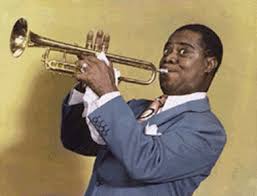
 Happy Fourth of July! Venerable Jazz Scholar Admits: Negro Musicians Had No Sense of Swing, Had To Be Taught By Louis Armstrong
One of the benefits of long-term unemployment is idle exploration, learning or freshening up on all kinds of areas of knowledge.
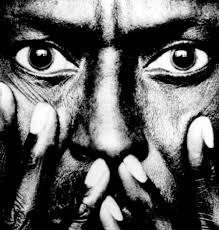
Now, long-time readers will know that there is no music I despise more than "jazz" [or "jizz" to give it its correct name] music; even [c]rap is simply verbal improvisation to records by people too lazy and talentless to learn an instrument, and its violence, misogyny and pomposity are clearly linked right back to the 'be-bop' era [think: sneering, "I wanna strangle a white man before I die," wife-beating Miles Davis].
For you non-New Yorkers, or the uninitiated, read more here.
Why my interest? Surely not the subject matter, but rather Schaap's indeed "Talmudic" or even autistic obsession with the minutiae of Charlie Parker's music, playing not just songs but sections, even notes, over and over, looping them in various sequences, to illustrate arcane questions such as 'when did Charlie Parker first use this note, and why.' I think I've really come to understand what 'be-bop' was all about, which is simply an interesting piece of historical knowledge; my loathing remains intact. After all, Jews devote their entire lives to studying and reliving minutia of "The Holocaust," right?
Now, one thing WKCR does is run equally insane marathons, such as playing every one of Bach's works over a two week period in December, or devoting the weekend of July 4th to the music of Louis Armstrong [who in some convoluted way is supposed to "share America's birthday," only not really, so they do another one later in the year].
Now, around the 6 o'clock hour on Saturday the Fourth, I was listening to Mr. Schaap when he dropped this bombshell, in his inimitable way:
[No transcript, of course:] "Now, listen closely to the solo here [a song called Copenhagen], where Pops takes his solo. Now, I know its hard to listen to these old 78s. [One of Schaap's endearing traits is his need to explain every detail of how people used to go about recording, or listening, or even buying, these "records" in the old days. "They had a lot of these stores, see, you could go to..."] The band [Fletcher Henderson's orchestra] sounds a little herky-jerky, but that's how jazz music sounded then. Now if you listen to Pops, you can hear the difference. Pops swings, and he had to teach that to these musicians in New York.
Whaaaaaaaaaaaat? According to Wikipedia:
In 1922 he formed his own band, which was resident first at the Club Alabam then at the Roseland, and quickly became known as the best "Black" band in New York.
But apparently, the "best 'black' [sic] band in New York" didn't know how to swing. Wiki puts it a little differently:
[B]ut when Louis Armstrong joined his orchestra in 1924 Henderson realized there could be a much richer potential for jazz band orchestration.
Uh huh.
So much for the myth of the American Negro and his "swing." Now, of course I am well aware that "Pops" was himself of the darker persuasion, but by admitting that even the "best black band in New York" needed to be taught to swing, Schaap blows the who myth out of the water. If 'swing' [aka 'natural rhythm'] is not only not genetic but actually taught, then it follows that there is no reason to expect a particular negro to 'swing,' nor that a particular White cannot. I may not dance well, but Fred Astaire does, and the whole racial question drops out as irrelevan
 t.
In fact, White men also taught negroes to swing; Aryan musician Bix Beiderbecke, for example:
Beiderbecke's influence was most noticeable amongst white musicians, but black players also fell under his spell, notably trumpeters and cornetists John Nesbitt (of McKinney's Cotton Pickers), Rex Stewart of (Fletcher Henderson's Orchestra, Duke Ellington's Orchestra), and Doc Cheatham of (Cab Calloway's Orchestra). Miles Davis was fascinated by Beiderbecke's playing, and sought out people who had known and played with him. Davis' silvery tone and understated, "cool" phrasing clearly hark back to one aspect of Beiderbecke's style. Jazz guitarist George Barnes stated in a 1975 Guitar Player interview: "When I was 11, I heard some Bix Beiderbecke records featuring Joe Venuti. I knew then that I wanted to be a jazz musician."
Etc.
So much for the 'natural musicianship' that "created America's only cultural innovation" and other PBS-addled nonsense.
What a week! First, the "King of Pop" dies, then Pops puts the kibosh on Jizz! Must be some kinda rayzizm goin' 'round.


No comments:
Post a Comment